Friday, 15 October 2010

The Most Extraordinary Place You've Never Heard Of

Ask a group of people to name some of the world's great ancient sites, ruins or monuments and the usual suspects will all probably get an airing. The Pyramids, the Colosseum, the Parthenon or Stonehenge for starters. Some will venture further afield - Machu Picchu, the Easter Island Statues, Angkor Wat and even Chitchen Itza in Mexico might get a mention. But one that will almost certainly be absent from the discussion is the astonishing site of Bagan, in central Myanmar. This is a shame, because in my humble opinion it stands comparison with absolutely any of them. Bagan consists of over 4,000 temples - ranging from tiny to huge - scattered over a vast plain, the sheer scale of which puts most other sites in the world to shame.

Being the fan of the ancient that I am, Bagan was at the top of my Myanmar to-do list, but even I will admit to being pretty unfamiliar with it before I got here. Needless to say, though, that after having such fantastic experiences in the country so far and leaving this for the big finale, it had plenty to live up to.

Arriving in the evening, there wasn't much time for immediate sightseeing and so Jen and I checked into our (again very nice) hostel and decided that our plan for the following morning would be to hire a horse and cart (and driver, obviously) to take us on a full day tour of the plain. Given the weather, which had been wet but was now starting to clear up, had left a lot of the more remote areas difficult to access, our horse and cart proved to be the way to go. Starting after breakfast we began slowly, with a couple of the smaller - yet still very impressive - and more remote temples like these ones.


Had they been the top sights for the day, we'd have been pleased - but we were truly just getting started. And we quickly learned the golden rule of Bagan - no matter how spectacular any individual temple might be, it pales in comparison to the collective view. The temples of Bagan might just be Southeast Asia's first attempt at Socialism...


As the day went on we proceeded to visit some of the bigger and more spectacular structures, such as Dhammayangyi, a colossal red brick pyramid which is the largest of all Bagan's temples...


...and Sulamani, one of the prettiest and most intricate temples, which is just as impressive on the inside as the outside.


It wasn't just a temple day either - Bagan is probably the lacquer-ware capital of the solar system and we got to see the artists at work first hand. Intricacy personified...and patience too, as the process of making just one item can take up to two years.


Finally, to finish the day we were taken to what is considered one Bagan's finest viewing platforms...and to say that the view didn't disappoint would be to underrate it I'd say. Breathtaking isn't the word.


Such a day was clearly a hard act to follow, but never ones to believe that we've peaked too soon we attacked the following days with ever greater gusto, hiring bicycles to cover as much ground as possible and viewing even more of the highlights. One of these was Ananda, considered to be probably the finest and most beautiful of all Bagan temples.


As well as Thatbyinnyu, at 64m (over 200ft) the highest of all Bagan temples. Though it's fair to say that this one was something of a Monet - the closer you got, the worse it looked. Still hella impressive from a distance though.


So far, so blindingly brilliant - but the absolute highlight was still to come, and gave me one of those spine-tingling experiences that you always hope for as a traveller. Riding our bikes, we came across a path with no traffic on it at all and no other tourists in sight, which we then followed all the way to a lovely, secluded little temple with a viewing platform. So unvisited was this place that we had to ask the young woman who lived nearby for the key to open the gate to the viewing platform of the temple, which we climbed to get ourselves the best possible vantage point.


The views were magnificent, panoramas across the entirety of the plain, and despite the otherwise sunny weather we even got a rainbow seemingly beaming out of Dhammayangyi just for us.


And then, remarkably with the place entirely to ourselves, we were treated to simply the most epic sunset over Bagan.


Few things could possibly have made our time in Bagan even better, but that's exactly what happened with the arrival of Wojtek and Joanna, the Polish couple we travelled through Tibet with. As mentioned in the Tibet entries, they are on their own world tour and it was fantastic to meet up with them again.


Though I don't know where all those beer glasses came from. It seems the waiters at the bar had carelessly left other people's empties on our table...

And so ends Bagan, truly one of the most remarkable, beautiful places I've ever seen. We didn't make it to all 4,400 temples, but we gave it a hell of a shot. Just one more (long) bus ride back to Yangon and we will be leaving this wonderful country behind.

Things Jennie will remember:

1) HA HA HA!!! Sean!!! On a bike on sand!!!! HA HA HA!!! With a flat tyre!!!! And mud!! And thorn bushes!!!
2) The all-you-can-eat buffet at the Golden Myanmar restaurant. Four different types of meat curry (all with unlimited refills!) complimented by a table full of salads, vegetables and sauces (all with unlimited refills!!) - we actually had to force them to stop bringing the food to the table as it just kept coming and coming and coming. And coming!
3) Zu Zu, our very knowledgeable horse cart driver. Thanks Zu Zu!


Here are the photos:

Sunday, 10 October 2010

Like Waterworld. But Good.

Day one at Inle lake. Having arrived hiddeously early off a very cramped 10 hour bus ride from Toungoo, Sean and I found ourselves a nice hostel and promptly went to sleep. Upon waking we wandered around the beautiful village of Nyaung U at the north end of Inle Lake. The standard stupas abounded but the lazy feel and laid back aura hit you right away. We knew instantly that we wanted to stay here for a good few days to really soak this up, something which was confirmed as soon as we were told that the annual boat race festival was to be held from 9-17 October and that the opening ceremony was on the coming weekend. The upshot of this was that we were definitely now going to miss out on going to Mandalay in favour of staying at Inle, which we were more than OK with (the fact that Mandalay is apparently over 40 degrees right now and requires an extra 10-15 hour bus ride to get there helped our decision too...).


On Day Two we did the obligatory 'boat tour' of the lake with a Spanish trio of Pedro, Lluma and Andreo who were staying at our hostel. This is a fab thing to do. Not only do you see beautiful 'houses on stilts':


But you also stop at a village that had a market (ok, so ignore the people trying to sell their wares if you wish and just see the locals shopping). We also took in stops at weaving, cigar, silver jewellery and parasol makers. Again, so they ask you to 'look, no buy, no problem' at the end, but their 20 minutes introduction and demonstration at the beginning is worth it! Especially to see the local women in their traditional 'thanaka' make-up:


We also visited Shwe Inn Thein Paya, the place of 1054 stuppas and counting!


And the piece de resitance, the jumping cat monastery - no words, just view the video:


Day three saw us trekking into the mountains to the east of Inle Lake. Our guide was called Wim, and he was really lovely. For a short man he did, however, walk at the speed of a cheetah running. This turned what he called an 'easy' trek into something I'm sure would feature well in the iron man competition as we practically ran both up and down the main feature moutain of our trek. It's at times like these that I often ponder about our friends James and Anne, who I always imagine would be bounding past this cheetah guide, even with baby Grace strapped to their backs, not even breaking a sweat. This is the opposite image to that of Sean and I, who were huffing and puffing more than the wolf in the Three Little Pigs.

We were grateful to arrive at our first stop, a cave that a monk has turned into his home and his own meditation area. We sipped green tea and ate bean crackers and our guides' father's home grown bananas (Sean ate 3 and he hates the things!). The cave was all in all bigger than most London flats and I'm confident to say tidier than most I should imagine.

We passed through several Pa-o villages next all the time climbing higher up the mountain and admiring the views. Pa-o are a tribe of Shan, Shan being the district in Myanmar that Inle is in. The women in these villages are easy to spot as they are the ones who wear the checked cloth on their heads (or sometimes what really does look just like a beach towel).


I also learned a lot, like that the house walls are made out of bamboo and the roofs are made from sugar can leaves, that there are plants that you can blow bubbles from the juice in their stem:


that you can eat bamboo roots (apparently they make good soups), that cows don't walk well on rocks (we passed a herd being shepherded down the small mountain trail, scared by what I can only imagine was this sight of Sean:


and they tried to pass too far away, slipped on the rocks and almost fell down the mountain), that orange maize is for animals and not people as it's too strong, what jack fruits are (southern hemisphere folks please remember I'm from England),


that the leaves of Teak trees turn your hands red if you rub them (I thought it was just the bark), and most importantly that Myanmar has to be a contender for THE most friendly place on earth. Everyone here smiles at you and says "Min gala ba" (aka 'Hello'). Or "Happy Nice Day". The children don't demand money off you (ok, so this may come with time and increased tourism) but instead with smiles and curiosity (and sometimes horror at how tall and scary Sean is).


We had lunch with a Pa-o family at the top of the mountain and entertained 6 children by taking their pics/videos which they found most amusing (shame that we couldn't record their reactions when they watched the video playback). Anyway, check out the video links on YouTube regardless.


Another monastery and Tai Yai village later (plus many more happy children) and we were back home. Tired, happy and loving Myanmar all the more. I will never forget the wonderful little boy who ran up to me and simply gave me a flower.... bless!

On Day Four we lazed around on the balcony reading 'Burmese Days' (I don't know why I'm writing this blog as Sean keeps wanting me to add things like: "Burmese Days is George Orwell's first novel, inspired by his time stationed here with the British army") and then took in the "sunset" on a traditional canoe trip around the canals on the north of the lake. "Sunset" is in inverted commas because there technically wasn't any sun as it was very cloudy. The trip itself however was lovely and relaxing and encountering water buffalos lazing around in the water all the time still made it an interesting afternoon. We also sampled rice balls (very dry and sweet - water needed to swallow them!) that were being made by a village for the forthcoming boat race festival.


Day Five was a crazy early 4.30am start to hot foot it down to the southern part of the lake in order to see the opening ceremony of the festival. Imagine an English village fete with floats, but on long boats. Every village had their own boat which they decorated with palm leaves and umbrellas and flags. It was manned by (we assume) every man and boy from that same village and they 'leg rowed' the boats from Phaung Daw Oo Paya to Shwe Inn Thein Paya. At the end of the procession was the main attraction - a boat with food offerings and then the crowning jewel - the 5 buddha statues themselves. After watching them all set on their way, we sailed to the next town to see their arrival, where all the offerings were unloaded and marched up to the temple. The locals were all out in force (so much so that our view ended up being a bit obscured as we let the locals get to the front), but it was lovely to watch everyone enjoying themselves, eating, drinking and being thoroughly merry! We were very lucky that our timing allowed us this priviledge.


And then it was time to leave. And that was a really sad day. But we had one final attraction to visit in this country - the main thing we'd come to Myanmar to see... Bagan.

Things I'll also remember:
1) The wonderful owners of Min Ga Lar Inn and the lovely lime juice drinks they gave us when we got back 'home' at the end of each day
2) Star Flower restaurant and their fresh basil (where we ran into Wim, our trek guide)
3) Braised chicken and Mint curry at Unique restaurant (a local Shan dish)
4) Aurora restaurant's generosity with portions and 'freebies' such as soup, crackers, salads, tea...
5) Running into Lisa and Partner from our Flight of the Gibbon zip wire rides in Thailand at our hostel

Here are the photos:

Tuesday, 5 October 2010

Testies Survival Kit: Matches

ITEM USED: Matches
COUNTRY USED IN: Myanmar
CHALLENGE OVERCOME: The Mosquito

In Toungoo, Jennie was tired of being bitten by mosquitoes. She delved into her Testies Survival Kit and used the matches to light a mosquito repellent coil called 'Godzilla' in order to keep those pesky pests at bay!


NOTE: I am actually extremely grateful for this particular kit item. I have so many bites all the time and these coils really seem to help. I have also recently seen that I shouldn't be carrying matches even in my check-in luggage on planes, so it's a good job that I have almost finished them! (but not good news for my poor ankles)

Weirdest. Place. Ever.

This deserves its own entry.

The long, overnight bus trip from Toungoo to Inle Lake provided me with one of the most surreal travel experiences of my life. In 2005, reportedly after advice from his astrologer, Myanmar's leader Than Shwe decided that Yangon wasn't to be the capital any more and that he (or rather a lot of his worker drones) would build a brand new capital on the central plains of the country. The shiny new city of Nay Pyi Taw (hilariously meaning "Abode of the Kings") was the result, and our bus journey took us through it for a close-up look.

And what a look it was. You knew it was coming long before you saw it - the road suddenly became wide, smooth and well-lit (three things that every other road in Myanmar isn't), and a surprisingly jovial Government checkpoint took a gander at IDs (for the locals) and passports (for Jen and I) before letting us through. Once into the city proper, we were suddenly transported to the Gold Coast or Southern California, but in the middle of Myanmar. There were palm trees, grand boulevards, huge shopping malls, five star hotel villas...and no people. It was like someone had designed a suburban utopia and then forgotten to invite anyone to live there. The Government is clearly trying to impress people with its new capital, and by God they don't want any of the pesky local masses ruining it for them, so as it stands the capital city is a disturbingly grand yet largely empty ghost town, where the regime leaders, I assume, hang out in their air conditioned villas and play golf at their exclusive resorts.

Best (and by "best" I of course mean "weirdest") of all is the mighty monument in the centre of town - an exact replica of the gleaming Shwedagon Pagoda in Yangon, built in just a couple of years (the original took about 2,500 to reach its present status) by the Generals in order to legitimise the city. For it to stand out as such a colossal waste of money in a place where "what a waste of money" could be inscribed on the town coat-of-arms is a truly breathtaking achievement. I'd wonder about how many of Myanmar's poor, hungry and homeless could have been fed, clothed and housed for life on the budget of this new capital, but I fear if I think too hard about it I'll want to slit my wrists.

Weirdest. Place. Ever. And, in its own way, probably the most vulgar and disgusting as well. This country deserves so much better.

Monday, 4 October 2010

Toungoo - Funny Name, Fabulous Town

If Yangon was an interesting introduction to Myanmar, then Toungoo is the place that has made us fall in love with this country. Jen and I were keen to break up the long journey between Yangon and Inle Lake with a stop somewhere on the way to get away from the tourist trail and Toungoo fit the bill nicely. To be honest, this dusty old town is actually "on" the tourist trail as pretty much every bus between Yangon and Inle passes through here, but very few travellers actually get off the bus and so end up seeing the place purely out of a moving window. Jen and I decided to buck that trend.

And we are so, so glad we did. Let's get this straight - there is virtually nothing to see or do as such in Toungoo, it's not a tourist attraction in any real way, shape or form. And this is precisely the town's appeal - it's "real" Myanmar, a place to get away from the tourists and the touts and engage with the locals. For starters, our guesthouse was a gem. It's something of a paradox that one of Myanmar's loveliest and most celebrated guesthouses is in a place that gets few tourists, but who cares for such details when you have a room like this?


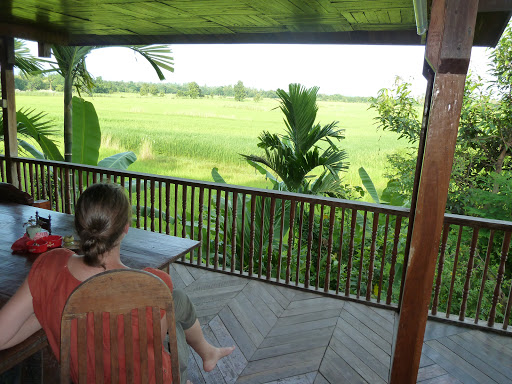
A verandah like this?


Or a view like this?


It was just like being on our own sugar cane plantation. We ate tropical fruit, drank fresh lime juice and ate the most staggeringly indulgent local breakfasts brought to us by staff who couldn't do enough to help (seemingly a common trait among the people of this country).

To top it off, we had two wonderfully memorable nights out. Having searched quite thoroughly and found, to our delight, that we were the only foreigners in town, we did what any good out-of-towners would do - we went and got drunk with the locals. The first night involved dinner at a local restaurant called "Happy" where we ate excellent, cheap food, drank excellent, cheap beer and befriended a truck driver who had clearly indulged in far too much of the latter and not nearly enough of the former. He was passing through Toungoo on a job and was missing his family in Yangon who he hadn't seen for some time. Jen and I (perhaps unwisely) bought him another drink and he took to us like family, telling us his life story and making us promise that we would not forget him. Well, we're told that's what he said because he didn't speak any English, and so our waiter - who spoke quite good English - was roped into joining us at our table to translate the conversation both ways. Eventually our new friend became so drunk that he started muttering to himself. We looked hopefully at the waiter to translate, only for him to deadpan "I'm sorry, even I don't know what he's saying now."

We decided that Mr Min (our truck driver friend's name) needed some rest so we took him to his truck for some much needed sleep - though, clearly with ambition undulled by drink, he thought we wanted him to drive to the next town and so started his preparations for the journey. Thankfully, we managed to take his keys and he passed out roughly four seconds later. We certainly won't forget him.


Our second night involved drunken shenanigans with Mariano, a young football-obsessed lad (as is just about every male in Myanmar - football, particularly the English Premier League, is beyond massive over here) who was one of our brillant staff at the guesthouse. We'd struck up a conversation at breakfast and found that he and a friend were going to watch the evening's matches at a local beer station, and he asked us to come. So, enticed by the unbeatable prospect of adding football to beer, we joined them.

A bike ride took us to the beer station - it's said that you never forget how to ride a bike but in the fifteen years or so since I was last on one I've given it a real shot. Still, I managed to just about get there in one piece and celebrated with the imbibing of large quantities of the local brew, eventually having to apologise to the entire place for my unbridled celebration when Blackpool scored their second against Liverpool. Mariano had an accumulator on all three games that involved him wanting Liverpool (and Manchester City) to win their matches and so Jennie, in support of our new friend, cheered for both those teams over the course of the night. She thought I was joking when I told her the wedding was off, which was kind of cute.

Despite the question of loyalty, however, it was another absolutely cracking night.


Mariano, his family and his home village are all Christians (rather than Buddhists, which is the dominant religion in the country) and he gave us the most brilliant explanation why. In the old days, his tribe village didn't actually have a religion at all. When the Buddhists came to convert them, they described the hard life of abstinence and endeavour that comes with their beliefs, which the villagers thought sounded too much like hard work. The Jews came and told them they couldn't eat pig - to which their reply was "but we like eating pig!" - and so Judaism was out too. Then the Christians came and told them they didn't have to give up anything or work particularly hard or even go to church and pray very often...so the village decided Christianity was definitely the way to go.

Sadly our beautiful but all-too-brief affair with Toungoo is at an end - the bus to Inle Lake awaits. Some of the greatest experiences you can have as a traveller come when you're least expecting them. Toungoo was such an experience, and will stay with us for a long time.

Things Jennie will remember:

1) The wonderful and sweet Mariano and his congratulations-on-your-engagement 'card' set neatly to a bunch of flowers for us one breakfast.


2) Mr Min Thein Htut (age 30 yrs) - the drunken bus driver that we met in "Happy" restaurant - we will not forget you sir!
3) Being on The Road To Mandalay:


4) Ha ha ha. Sean. On a bike. Ha ha ha.

Here are the photos:

Friday, 1 October 2010

A Country By Any Other Name...

Our gateway to the mysterious, secluded world of Myanmar (yes, we used to know it as Burma) was Yangon (yes, we used to know it as Rangoon), the now-former capital but still biggest city. We arrived with plenty of excitement and an even greater amount of US Dollars, as they are the only currency that can be exchanged in this country and there are no such things as ATMs or facilities that accept credit cards. It's also worth noting the curiosities of the exchange rates here. If you go to any bank in the world, or online to any currency exchange website, you'll find that US$1 will officially get you about 6.20 Kyat (the local currency of Myanmar, pronounced chat). Never, ever do this. When you get in-country and exchange money the same way everybody else does, on the black market, you will get between 900 and 1000 Kyat to the dollar. No, that's not a misprint and I haven't forgotten any decimal points - the "official" exchange rate undervalues the currency by a factor of roughly 150. Crazily, the 1000 Kyat note is the most common one handed out, and so Sean found that exchanging 100 US dollars left him with some logistical problems:


We only intended to stay in Yangon for one day. But a small bout of illness from Sean extended this to 3. The first day we spent wandering around the city center taking in the old Colonnial architecture mixed with the shiny Pagodas and temples. The streets were filled with markets (the Indian quarter, the Chinese quarter etc) and they reminded me a little bit of India but without all the dirt. Yangon has clearly suffered since the government decided on a whim five years ago that it was no longer Myanmar's capital city (Sean has more to say about this later) and took away all that government funding to its infrastructure and paintwork. But it remains the commercial and economic heart of Myanmar.

The massive Shwedagon Pagoda is the central sight to visit here. The entrance fee is 10 USD. Well, it's advertised in USD, but would they take our dollars? Would they heck! It's a problem here that if you have even the slightest mark on your "must be completely flat and not an old serial number" note that they won't accept them. So she asked us instead to pay in 10,000 Kyat, which is a bit of a rip off when the dollar is so low that 10,000 kyat is actually more like 11 USD. But what choice do you have when there aren't any ATMs and you can only use the notes you brought with you? Watching the sunset over Shwedagon though was worth it in the end (sorry for partly funding the government here, but we had no choice).


They do like their Buddha images to be lit up like Vegas here though:


So a nice day wandering around, we got a really good feel for Yangon and an intro to Myanmar (common sights like men in skirts called 'longyi' and beetlenut chewing folks with vampire red teeth), then poor Sean got sick and spent most of the next two days in bed. I caught up on some reading and played nurse-maid (no, not in that way).


PS: Did you know that the reason they changed the name to Myanmar was by way of distancing the country from its British Colonial days? The brits adopted the name 'Burma' as a bastardization of the word Bamar, which was the name of the dominant local people. And I think that Myanmar has mores roots in the country's original history. That being said, we should probably start dropping the bracketed "(Burma)" after this country's name now I reckon.

Here are the photos: